Recycling and Sustainability — Commercial Waste Docklands
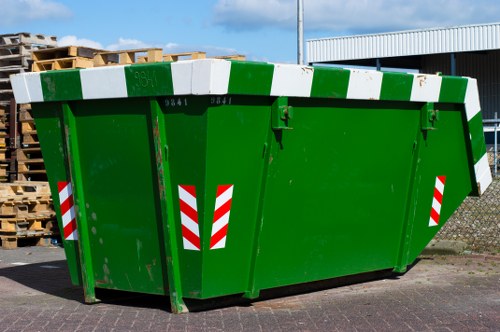 Commercial Waste Docklands is committed to creating an eco-friendly waste disposal area that supports businesses across the Docklands in reducing landfill, cutting carbon emissions and improving local resource recovery. Our approach balances practical collection services for shops, offices, construction sites and hospitality with an overarching strategy to make the sustainable rubbish area accessible, reliable and measurable. We work with local boroughs, transfer stations and community partners to embed circular-economy thinking into daily waste operations and help businesses meet regulatory and corporate sustainability goals.
We support borough-level separation schemes and mirror municipal systems so commercial collections align with household sorting. In Docklands this means collaborating with Tower Hamlets, Newham and Greenwich initiatives that emphasise separate streams for food waste, glass, dry mixed recycling and residual waste. Aligning with the boroughs’ approach to waste separation improves quality at source, reduces contamination and increases the volume of material viable for recycling and reprocessing.
Our Recycling Percentage Target
We have set a clear recycling percentage target: achieve a 70% recycling rate across all commercial accounts by 2030. This target covers diversion of organics, paper and card, metals, glass and construction materials where applicable. It is supported by incremental milestones, reporting dashboards and incentives for clients who adopt source segregation and reuse practices. The 70% target is ambitious yet achievable through consistent sorting, improved logistics and partnerships that prioritise reuse over disposal.
Local Transfer Stations and Logistics
Efficient transfer stations and consolidation hubs are central to an effective eco-friendly waste disposal area. We operate with and route through local transfer stations such as Beckton and Silvertown transfer hubs, enabling short-haul consolidation that reduces journey times and emissions. These facilities allow for pre-sorting, baling of paper and card, and temporary storage of segregated streams before they move to specialized recycling processors, anaerobic digestion facilities for organics, or approved construction waste recyclers.

Partnerships with Charities and Reuse Networks
Reducing waste is not only about recycling—reuse is a powerful lever. We partner with a range of charities and reuse organisations to divert items suitable for resale or refurbishment. Partners include national and local charities that accept commercial donations of furniture, textiles, small electricals and surplus catering equipment. Our partner network includes organisations focused on social value, enabling goods to be recovered, repaired and redirected into community benefit rather than entering the waste stream.
Low-Carbon Fleet and Collection Technologies
To support a sustainable rubbish area we maintain a mixed fleet with a strong focus on low-carbon vans and trucks. Our fleet strategy includes full-electric vans for last-mile collections, hybrid vehicles for mixed-route flexibility and low-emission Euro VI vehicles for longer runs. Using electric and low-carbon vans reduces local air pollution in the Docklands and cuts scope 1 emissions from collections. We also invest in route-optimisation software and telematics to minimise miles driven and improve load factors.
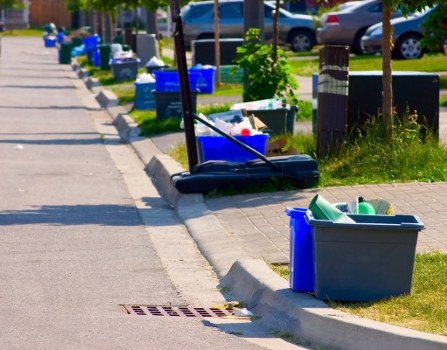
Operational measures include the provision of segregated containers for businesses, regular driver training on contamination reduction and scheduled audits to monitor recycling performance. We supply clear signage and colour-coded bin systems that reflect the boroughs’ separation standards: food/organics in one stream, mixed dry recycling in another, with glass and cardboard separated where required.
 What We Collect and Recycle
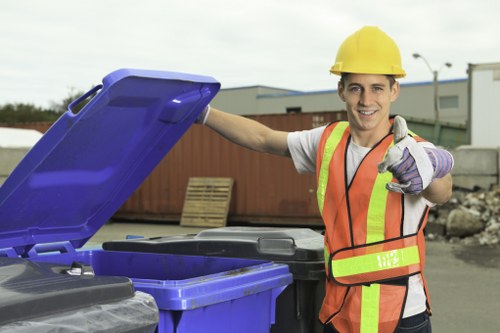
The Docklands commercial profile means we manage a broad range of recycling activity: office paper and card, mixed packaging, glass from bars and restaurants, commercial food waste from catering operations, textiles from hospitality and minor construction and demolition waste from fit-outs. For larger projects we provide segregated skips for inert materials, timber and metals and coordinate with certified processors to maximise recovery rates. Our sustainable rubbish area is designed to handle both routine business waste and one-off clearances in a way that prioritises reuse and material recovery.
Reporting, Targets and Continuous Improvement
Transparency and measurement are core to reaching our recycling percentage target. Clients receive regular reports detailing tonnes collected by stream, contamination rates and carbon savings from use of low-carbon vans and transfer-station consolidation. We set bespoke reduction plans for high-volume producers and work with facilities managers to trial interventions such as front-of-house food-waste collections and back-of-house separation audits. These targeted actions help move sites toward the 70% recycling goal and reduce overall waste costs.
Community and corporate partnerships are essential to scale impact. We engage with local charities for reuse, collaborate with council recycling officers on joint campaigns and provide training sessions for staff to reinforce correct sorting practice. Our approach builds on local policy and the practical reality of commercial operations in the Docklands to deliver measurable sustainability gains.
Summary: Commercial Waste Docklands delivers a pragmatic, resilient and measurable model for an eco-friendly waste disposal area and a thriving sustainable rubbish area. Through clear targets, local transfer stations, charity partnerships and a low-carbon fleet we help businesses reduce waste, increase reuse and reach ambitious recycling outcomes while supporting local communities.
